



• Home
  • About
    • Being Meraklis
    • Shwetha Sivaraman
  • For Individuals
    • Find Your Calm
    • Discover What’s Next
    • Conquer Mental Barriers
  • For Corporates
  • Resources
    • Blog
    • Podcast
    • Free Courses
    • Subscribe
  • Contact Us
  • Home
  • About
    • Being Meraklis
    • Shwetha Sivaraman
  • For Individuals

      Find
      Your Calm

      Learn More

      Discover
      What's Next

      Learn More

      Conquer
      Mental Barriers

      Learn More

  • For Corporates
  • Resources
    • Blog
    • Podcast
    • Free Courses
    • Subscribe
  • Contact Us

  • Home
  • About
    • Being Meraklis
    • Shwetha Sivaraman
  • For Individuals

      Find
      Your Calm

      Learn More

      Discover
      What's Next

      Learn More

      Conquer
      Mental Barriers

      Learn More

  • For Corporates
  • Resources
    • Blog
    • Podcast
    • Free Courses
    • Subscribe
  • Contact Us

#ThriveConsciously  ·  Meraklis Musings

Arjuna’s Grief or a profound expansion of the Psyche?

By Shwetha Sivaraman 

The first time I read Chapter One, I thought it was a bit of a dull start to a scripture that promises so much wisdom on self-mastery. Verse after verse, the chapter first lists facts along the battlelines. Who is standing where, what weapons do each of them hold, on and on, setting the scene of the battlefield in excruciating detail. I couldn’t help but wonder why Krishna bothered with this level of detailing.

To top it all, the name of the first chapter is Arjuna Vishada Yoga or Arjuna’s Grief. In a world where we are impatient and want life’s hacks in 30 seconds, devoting a whole chapter to the many ways Arjuna grieved on the battlefield felt pointless.

I realised many years into my study of the Gita that this chapter is not a whiny expression of the many ways Arjuna felt miserable, but a profound expansion of the psyche. What happens to Arjuna when he breaks down on the battlefield is also what happens to us when we face life’s many curveballs.

So the first chapter is not a series of factoids or a gossip column on how Arjuna broke down, but a mirror to recognise our patterns. How do we react when things don’t go as planned? What do we do or not do in those scenarios? What happens within us when we encounter life’s obstacles? What are our dominant behavioural patterns when in crisis?

Chapter 1 of the Bhagavad Gita helps us understand this by reflecting on both Duryodhana’s and Arjuna’s reactions on seeing the opponents on the battlefield. Understanding these patterns is the beginning of self-mastery. 

As I share their reactions, reflect on your patterns. What reactions resonate with how you respond to life’s chaos? We need to see it first before we work on it. 

Duryodhana’s reactions

  1. Talking too Much (Verses 1.4-1.6) – Duryodhana’s reaction on the battlefield is a classic sign of insecurity. He feels afraid of facing powerful warriors on the Pandavas’ side, and to compensate for this fear, he goes on and on talking about how the warriors on the Kauravas’ side are no less. In saying so much, he reveals his real fear of being bested by the competent Pandavas despite having numbers on their side. It’s interesting to reflect on the many ways we overcompensate in our external behaviours when we feel insecure – is it talking too much, too little, pretending to know what we don’t know, hiding or avoidance.
  2. Arrogance (Verse 1.9) – Duryodhana, in this verse, goes on to say that great warriors like Bhishma and Drona are fighting for ‘his sake’ in the war. Arrogance or a misplaced sense of self-importance is another way we react when we feel the ground beneath us shaking.

Relevant Blogs

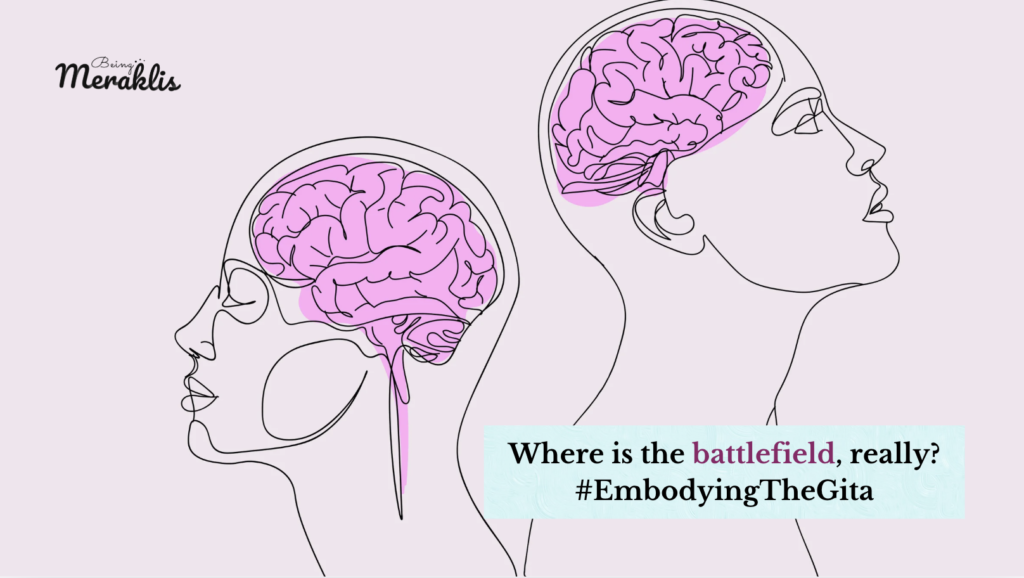
Where is the battlefield?

Why we suffer?

Arjuna’s reactions

  1. Psychosomatic Responses (Verse 1.29) – Arjuna, in this verse, shows how his mental anxiety is translating into physical symptoms powerfully. He says his limbs fail, his mouth becomes parched, his body quivers and so on when he sees who he needs to fight to win the battle. We’ve all experienced how our mental fears translate to physical responses – think migraine headaches (when we criticise ourselves or feel we are not good enough), acidity (when life doesn’t sit well), joint pains (when we are not willing to move forward), cough (when we feel we aren’t heard), and so on. Recognise in what ways your mental state translates to physical symptoms.
  2. Denial (Verse 1.31) – Arjuna then goes on to say that he doesn’t really desire victory. Doesn’t quite need the kingdom when that’s what brought them to the battlefield. He desires both, but when he sees the cost of such desires, he goes into denial, saying no good can come out of killing. It’s like us wanting to lose weight. When we see the cost of letting go of our favourite desserts and replacing them with a salad, we deny having the desire to lose weight in the first place.
  3. Delusion (Verse 1.32) – Delulu is solulu is not just our generation’s response. Turns out Arjuna experienced it too when he deludes and convinces himself that he doesn’t desire victory or pleasures. We also delude ourselves into believing that things are not as bad as they could be and stick around in a dead-end job or a toxic relationship. Self-mastery requires us to break free from these delusions and embrace reality as is. 
  1. Avoidance (Verse 2.05) – He then goes on to fantasise about taking up sannyasa and begging for a living rather than confronting the reality of needing to fight for his kingdom. This is classic avoidance, believing moving to faraway lands can resolve what feels unpleasant in the moment. Think about all the times you wished you could run away to the Himalayas rather than deal with life’s reality or challenges.
  2. Rationalising (Verse 1.35-1.37) – When Arjuna doesn’t get the validation from Krishna for not fighting his cousins in battle, he goes on and on giving more reasons to make his argument. He says, it’s not worth it, I’ll attain sin, etc, etc., hoping to rationalise poor judgment. We do this when we take a sub-par job or choose to stick to a relationship that has run its course, or behave in self-sabotaging ways. We rationalise it in retrospect to make us feel better about our poor choices.
  3. Catastrophising (Verse 1.40-1.42) – Arjuna then goes on to say how this is not just about him incurring sin, but could lead to society losing its moral fibre. How the culture will get eroded and how it can lead to the destruction of spirituality as a whole. This reflects a pattern of taking one small fact or event and exaggerating it into something much bigger in our heads. Think of the times you had a bad presentation or got a ‘we need to talk’ message from your boss, and you started catastrophising on how you were going to lose your job.
  4. Self-harm tendencies (Verse 1.46)- Then Arjuna, one of the greatest warriors goes on to say, better they kill me than me killing them. We all self-sabotage by causing harm to ourselves rather than fighting our battles. This doesn’t need to be suicidal tendencies. We self-harm when we doubt ourselves over and over again and keep playing small in life. When we continue to give in to our people-pleasing tendencies instead of nurturing our wants and desires. When we keep giving and giving without protecting our boundaries.
  5. Depression (Verse 1.47) – Arjuna gives up and puts down his bow, saying he won’t fight. We experience this in layers when we slowly withdraw ourselves from situations or people because we don’t have the energy to confront or move out of such situations.

Meraklis Insight of the Week:

Take a moment to reflect on what your dominant patterns are. Awareness of how we react is the first step towards knowing ourselves. We need to know how we fall off the wagon to recognise what we need to watch out for and take timely corrective measures.

Some prompts to reflect on:

  • What’s your go-to behavioural pattern when you face a challenge?
  • What does repeating this pattern cost you over time?
  • What signals help you recognise when this pattern is playing out again?
  • How would you like to respond differently to move towards self-mastery?

Emotional IntelligenceFinding ClarityMeditation & YogaSpirituality & Self-Discovery

Related Articles


Demystifying Attachments and how Self-Mastery can help us break-free from it
#ThriveConsciously  ·  Meraklis Musings
Demystifying Attachments and how Self-Mastery can help us break-free from it
#ThriveConsciously  ·  Meraklis Musings
How to act in the World as per Bhagavad Gita
#ThriveConsciously  ·  Meraklis Musings
One Assumption behind overthinking and One Antidote to resolve it

Leave A Reply Cancel reply

Your email address will not be published. Required fields are marked *

*

*

Where is the battlefield, really?
Previous Article
Unlocking Self-Mastery: How to find tranquility amidst the hustle?
Next Article

Quick Links

Home
About Being Meraklis
Shwetha Sivaraman
Free Courses
Podcasts
Blog

Quick Links

Find Your Calm
Discover What’s Next
Conquer Mental Barriers
For Corporates
Contact

Stay Connected

Linkedin Instagram Youtube Twitter
  • hello@beingmeraklis.com
Book an Appointment
© Copyright 2024 by Being Meraklis | Designed by Brand My Style